
Buying a property in Delhi-NCR can be exciting, but before you pay a token amount or sign an agreement, there is one important question you should answer:
Does the seller actually have the right to sell the property, and do the available records match the documents?
This is where a property title search becomes important.
In simple terms, a property title search means checking the available property documents, registration records, land records and other relevant information to understand the ownership and transaction history of a property.
For a property in Delhi, you can use the official Delhi registration search system. For a property in Ghaziabad or elsewhere in Uttar Pradesh, official systems such as IGRSUP and UP Bhulekh can help you check registration and land-record information.
But there is an important difference between finding a record online and legally verifying the title of a property.
This guide explains what you can check yourself, which government websites to use, what documents to compare and when a deeper property document review may be necessary.
Property Title Search: Quick Answer
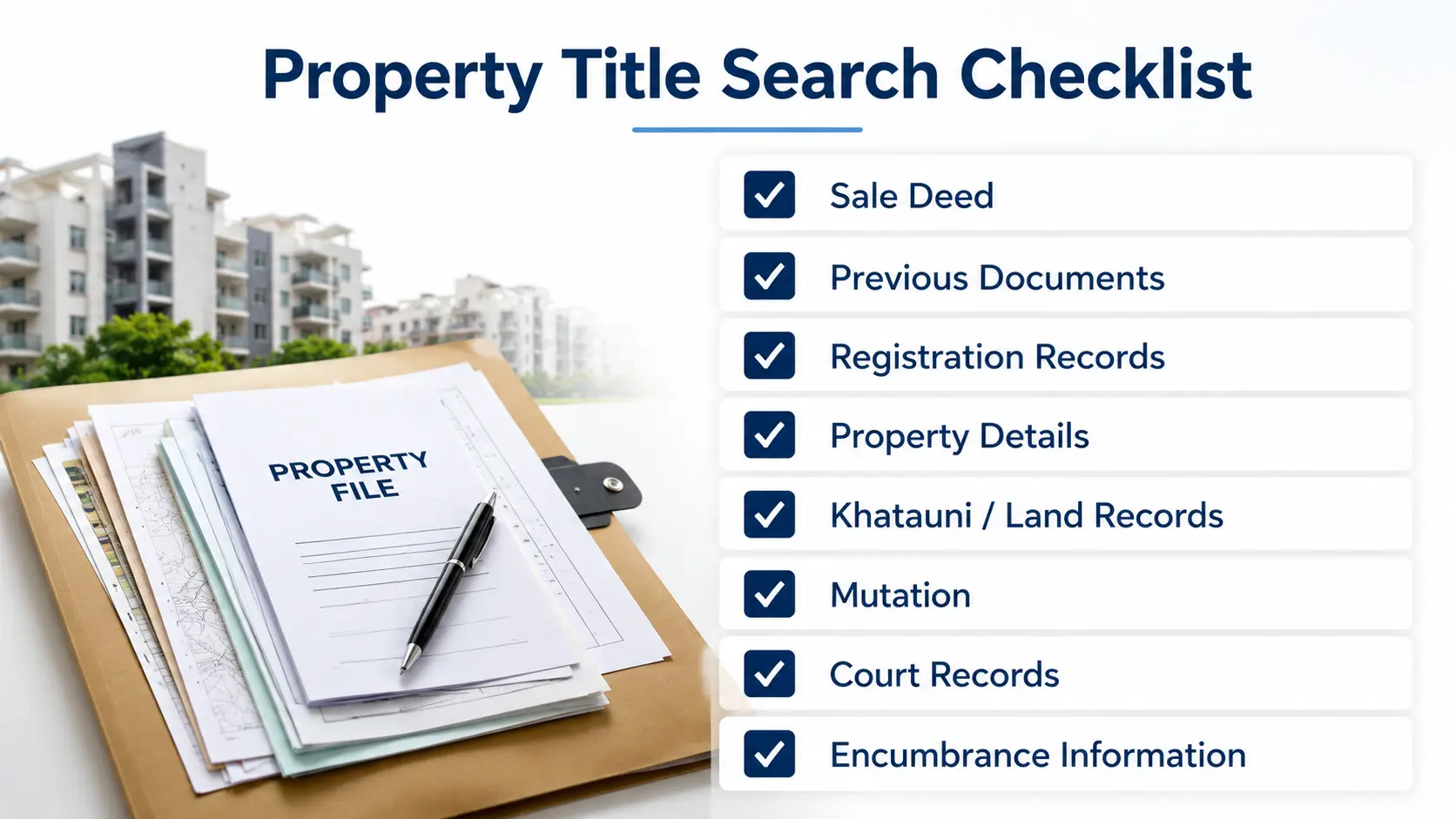
A property title search is the process of checking available documents and government records to understand the ownership and transaction history of a property.
Depending on the property, the search may involve:
- Bainama (sale deed)
- Previous sale or transfer documents
- Registration records
- Khatauni
- Khasra/Gata details
- Dakhil-kharij (mutation)
- Encumbrance-related information
- Court-case information
- Property tax information where relevant
- Builder or project documents where applicable
The important point is that one record alone may not tell the complete story of a property.
A buyer should compare the available records with the documents provided by the seller.
What Is a Property Title Search?
A property title search is basically a check of the paper trail of a property.
Suppose you are buying a flat in Ghaziabad.
The seller shows you a bainama and says:
“The property is in my name and there is no problem.”
Instead of relying only on that statement, you can check the available registration and land records and compare them with the documents.
You may want to know:
- Who is shown as the owner in the relevant records?
- How did the seller acquire the property?
- Is the registration information consistent?
- Do the property details match?
- Are previous documents available?
- Is there relevant land-record information?
- Are there court cases that require investigation?
- Are there any apparent discrepancies?
The purpose of a title search is therefore not simply to find a name online.
It is to understand the property’s documentary history.
Property Title Search vs Property Title Verification
These two terms are often used together, but there is a useful distinction.
Property title search
A title search generally means finding and examining relevant property records and documents.
Property title verification
Title verification goes a step further. The documents and records are examined together to assess whether there are gaps, inconsistencies or legal issues that require further investigation.
Think of it this way:
Search = Find the records.
Verification = Understand what those records and documents mean together.
This distinction is important because an online record may provide useful information without answering every legal question about ownership.
Why Should You Do a Property Title Search Before Buying?
Buying property involves a substantial amount of money.
Before proceeding, you may want to check whether the information given by the seller is consistent with the available documents and records.
For example:
- The seller’s name may need to be compared with the relevant documents.
- The property description may need to be checked.
- Previous transfers may need to be examined.
- Land records may need to be checked where applicable.
- Relevant court information may need to be investigated.
- Encumbrance-related information may need to be considered.
The Registration Act, 1908 provides for compulsory registration of certain documents relating to rights, title or interests in immovable property. It also contains provisions concerning the description of property in registration documents.
This is why the bainama, registry details and other relevant records should be looked at together, rather than treating one document as the entire property history.
What Documents Should You Ask the Seller For?
The exact documents depend on the property and the transaction.
However, before starting a detailed property check, you should try to collect the documents available to the seller.
These may include:
1. Bainama (Sale Deed)
The current sale deed is one of the important documents relating to a property sale.
2. Previous Sale Deeds
If the seller purchased the property from someone else, earlier sale deeds may help establish the transaction history.
3. Gift Deed
If the property was acquired through a gift, the relevant gift deed may be important.
4. Relinquishment Deed
This may be relevant in certain family or co-owner arrangements.
5. Partition Deed
If the property came through a family partition, the relevant partition documents may need to be examined.
6. Inheritance Documents
Where ownership came through inheritance, documents relating to succession may become relevant.
7. Registration Details
Keep details such as:
- registration number
- registration year/date
- deed type
- Sub-Registrar office
where available.
8. Land Records
For properties where revenue records apply, relevant information such as Khatauni and Khasra/Gata details may be important.
How to Check Property Title in Delhi
If the property is located in Delhi, start with the official Delhi registration system rather than relying on a private property-search website.
The current Delhi NGDRS portal provides two citizen e-search options:
DORIS Period — Before January 2024
NGDRS Period — After January 2024
This distinction is particularly useful when you are looking for older registration records.
Delhi NGDRS — Official Property Registration Search
Step 1: Collect the Property Details
Before searching, collect as much information as possible.
For example:
- seller’s name
- buyer’s name, where relevant
- father’s/husband’s name, where applicable
- deed type
- registration date
- deed number
- village
- taluka
- property details
- plot/property information
The current Delhi e-search system provides search fields including party name, father’s/husband’s name, deed type, party type, village, taluka, property attributes and deed number.
Step 2: Use the Correct Delhi Search Period
This is one of the most important updates for anyone reading an older article about Delhi property searches.
The official Delhi NGDRS website currently separates:
DORIS Period — Before January 2024
and
NGDRS Period — After January 2024.
So if you are looking for an older property transaction, don’t automatically assume that the newer search option is the only place to look.
Step 3: Search the Registration Record
Use the information you collected to search the relevant registration records.
The Delhi Revenue Department states that past property-registration details can be searched online through its official resources. It also provides links to registration-record searches, encumbrance search and other property-related resources.
Delhi Revenue Department — Registration of Property Information
Step 4: Compare the Record With the Bainama
Finding a matching name is only the beginning.
Compare the available record with the document.
Look at:
- owner’s name
- deed number
- date
- deed type
- property description
- property identifiers
- area, where available
- other relevant details
The Registration Act also contains provisions concerning the description of property in registration documents.
How to Check Property Records in Ghaziabad
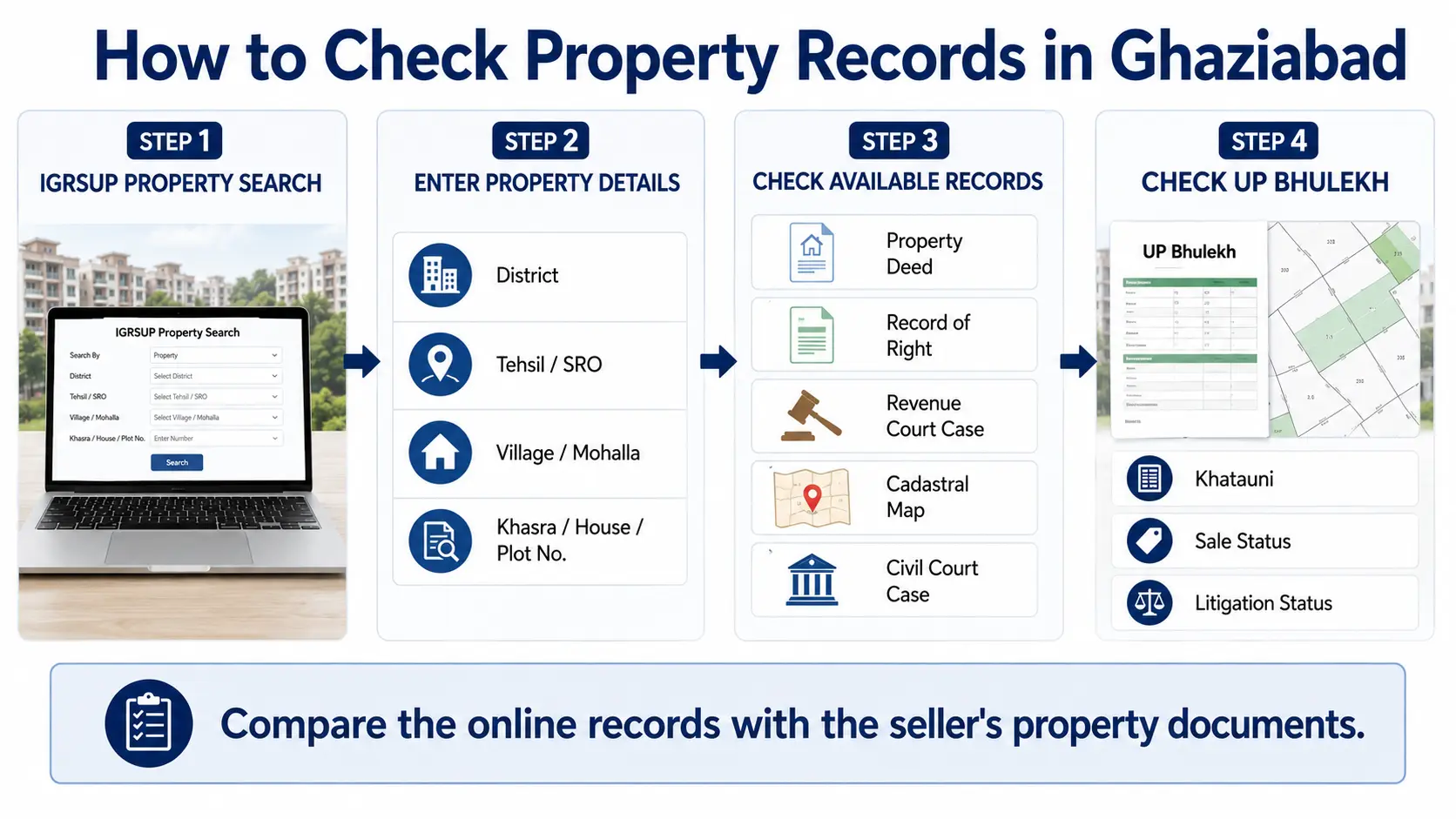
If the property is in Ghaziabad, you are dealing with Uttar Pradesh property and land records.
Two official government systems are particularly important:
IGRSUP
The Uttar Pradesh Stamp and Registration Department provides online services including:
- Property Search
- Property Details
- Registered Deed Certificate
- Certified Copies of Deeds
- Encumbrance-related certificate services
- Property registration services.
IGRSUP — Uttar Pradesh Stamp & Registration Department
UP Bhulekh
The official UP Bhulekh system is the state’s computerized land-record system and provides Real Time Khatauni.
UP Bhulekh — Official Uttar Pradesh Land Records
How to Search Property Information on IGRSUP
The official IGRSUP website currently provides a Property Search facility along with property details and registered-document services.
For a Ghaziabad property, start by collecting the information available to you and then use the official property-search facility.
Depending on the search and the available record, you may need information such as:
- district
- tehsil
- registration office
- year
- party name
- registration number
- property details
The exact search fields can vary according to the service being used.
The official IGRSUP website also warns that information displayed on the website should be verified and supplemented with documents ultimately issued by the concerned authorities.
That is an important point for buyers.
Don’t treat an online result as the final word on the property’s legal status.
How to Check Land Records on UP Bhulekh
For a property in Ghaziabad or another part of Uttar Pradesh, the official UP Bhulekh system can be used to access computerized land records and Real Time Khatauni.
Depending on the property and available records, you may need details such as:
- district
- tehsil
- village
- Khasra/Gata number
- Khata information
The information you find should then be compared with the property documents.
What Is Khatauni?
Khatauni is a land/revenue record used in Uttar Pradesh.
For a property buyer, it can be an important part of the land-record check.
However:
Khatauni should not automatically be treated as a replacement for the underlying title documents.
The wider property picture may also involve the registered documents, previous transactions, mutation and other relevant records.
What Is Dakhil-Kharij (Mutation)?
You may hear the term dakhil-kharij, commonly referred to as mutation.
It refers to an entry/change in revenue records following an event such as a transfer or succession, according to the applicable process.
There is an important legal point here.
Mutation does not itself create or prove title.
The Supreme Court has repeatedly held that mutation entries are for revenue/fiscal purposes and do not themselves confer title. The Court reiterated this position in a 2025 judgment.
So if someone says:
“My name is in mutation, therefore I am definitely the legal owner.”
that statement should not be accepted without examining the underlying title documents and circumstances.
Don’t Confuse Registration, Mutation and Title
These three things are related, but they are not the same.
Registration
The registration of documents through the relevant registration system where registration is required by law.
Mutation / Dakhil-Kharij
A change recorded in the relevant revenue records.
Title
The legal basis for a person’s ownership or rights in the property.
A property buyer should look at these matters together rather than treating one record as conclusive proof of ownership.
How to Check Property-Related Court Cases
Another important part of property due diligence is checking whether there are relevant court proceedings.
The official eCourts system provides several search methods.
You can search cases using information such as:
- party name
- case number
- registration year
- CNR number
- advocate
- FIR number
- case type.
eCourts — Official Case Status Search
For a party-name search, eCourts allows you to enter part of a name or the full name, with at least three characters, and select the registration year and case status.
But there is a limitation
A party-name search does not automatically prove that a property has no litigation.
There can be:
- people with similar names
- spelling differences
- cases in different courts
- cases involving different property descriptions
- matters that require examination of the actual case record
So treat the result as an important search step, not a final legal conclusion.
How to Check Encumbrance-Related Information in Delhi
An encumbrance generally refers to a claim, charge or other interest affecting property.
The Delhi Revenue Department provides an official process for a Non-Encumbrance Certificate.
The current Delhi government guidance states that the application requires documentary evidence showing ownership and other supporting documents. It is sent to the relevant Sub-Registrar for enquiry and report, and the department states that the normal response time is 21 days.
Delhi Revenue Department — Non-Encumbrance Certificate
This is another reason why you should be careful with statements such as:
“I searched the property online, so the property is completely clear.”
A property search and a formal certificate/process are not necessarily the same thing.
What Should You Compare During a Property Title Search?
Once you have collected the documents and records, compare them carefully.
| What to check | What to compare |
|---|---|
| Seller’s name | Documents vs relevant records |
| Bainama | Deed information and registration details |
| Previous documents | Earlier transfers where relevant |
| Property description | Address and identifiers |
| Area | Document vs available records |
| Khasra/Gata/Plot | Relevant property identifiers |
| Khatauni | Where applicable |
| Dakhil-kharij | Relevant mutation entry |
| Registration | Registration number/date/details |
| Encumbrance | Available information |
| Court cases | Relevant parties/property information |
| Inheritance | Succession-related documents |
| Builder property | Project and transaction documents |
7 Property Title Search Red Flags You Should Not Ignore
1. Seller’s name does not match the documents
Ask why there is a difference and what document explains it.
2. Property details do not match
Check the plot number, Khasra/Gata number, area, boundaries and other relevant identifiers where applicable.
3. Previous documents are missing
If the seller cannot provide an important previous document, ask why and whether another official record can help establish the transaction history.
4. Ownership history is unclear
If the seller’s explanation changes from one conversation to another, stop and investigate.
5. Mutation is being shown as the only proof of ownership
Remember that mutation itself does not confer title.
6. A court case appears
Don’t automatically assume that the property is disputed, but don’t ignore the case either.
Check whether the parties, property and facts actually relate to the transaction.
7. You are being pressured to pay quickly
A property purchase should not be rushed simply because the seller says another buyer is ready to pay.
Can You Do a Property Title Search Yourself?
Yes, you can do a preliminary property search yourself.
Delhi provides official registration-search facilities, while Uttar Pradesh provides IGRSUP and UP Bhulekh for registration and land-record information.
This can be a very useful first step.
But the difficult part is often not finding the record.
The difficult part is understanding what the record means when compared with:
- the current bainama
- previous sale deeds
- mutation
- Khatauni
- registration information
- court records
- inheritance documents
- property description
- other transaction documents.
That is why:
Online property search = preliminary check
Legal title verification = deeper document and legal review
Online Property Search vs Legal Title Verification
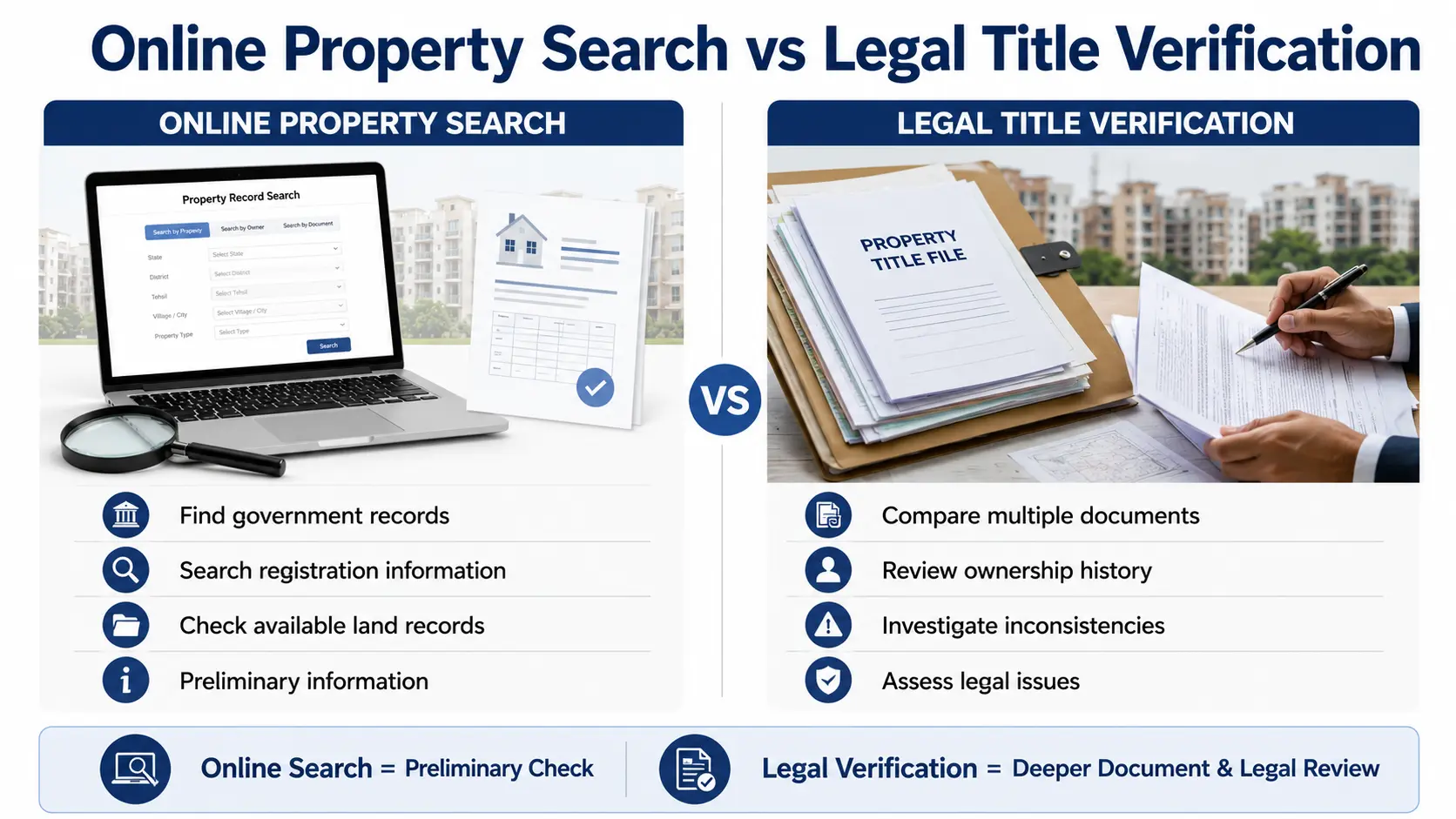
| Online Property Search | Legal Title Verification | |
|---|---|---|
| Find government records | Yes | Yes |
| Search registration information | Yes | Yes |
| Search land records | Where available | Yes, where relevant |
| Compare documents | Limited | Yes |
| Trace ownership history | Limited | More detailed |
| Investigate inconsistencies | Limited | Yes |
| Assess legal implications | No | Requires legal assessment |
| Property-specific legal review | No | Yes, where engaged |
The online search is therefore useful, but it should not automatically be treated as a complete title opinion.
How Many Years of Property Records Should You Check?
You may see websites recommending a fixed period such as 20 or 30 years.
We would not recommend applying one fixed number to every property.
The appropriate scope can depend on:
- the property
- the ownership history
- the available documents
- previous transfers
- inheritance
- disputes
- the nature of the transaction
- other facts specific to the property.
If the ownership chain is complicated, earlier documents may need to be examined.
The better question is:
Have the relevant ownership and transaction documents been sufficiently examined for this particular property?
What Is a Property Title Search Report?
A property title search report is generally a written result of examining relevant property documents and records.
The format can differ depending on the property and transaction.
A useful report may identify:
- documents examined
- ownership/transaction history reviewed
- registration records considered
- land records considered
- issues or gaps found
- documents requiring clarification
- matters requiring further investigation.
A title report should not be treated as a magical guarantee that the property can never be involved in a future dispute.
Its value lies in identifying and explaining the information and issues found during the review.
Delhi vs Ghaziabad: Which Government Portal Should You Use?
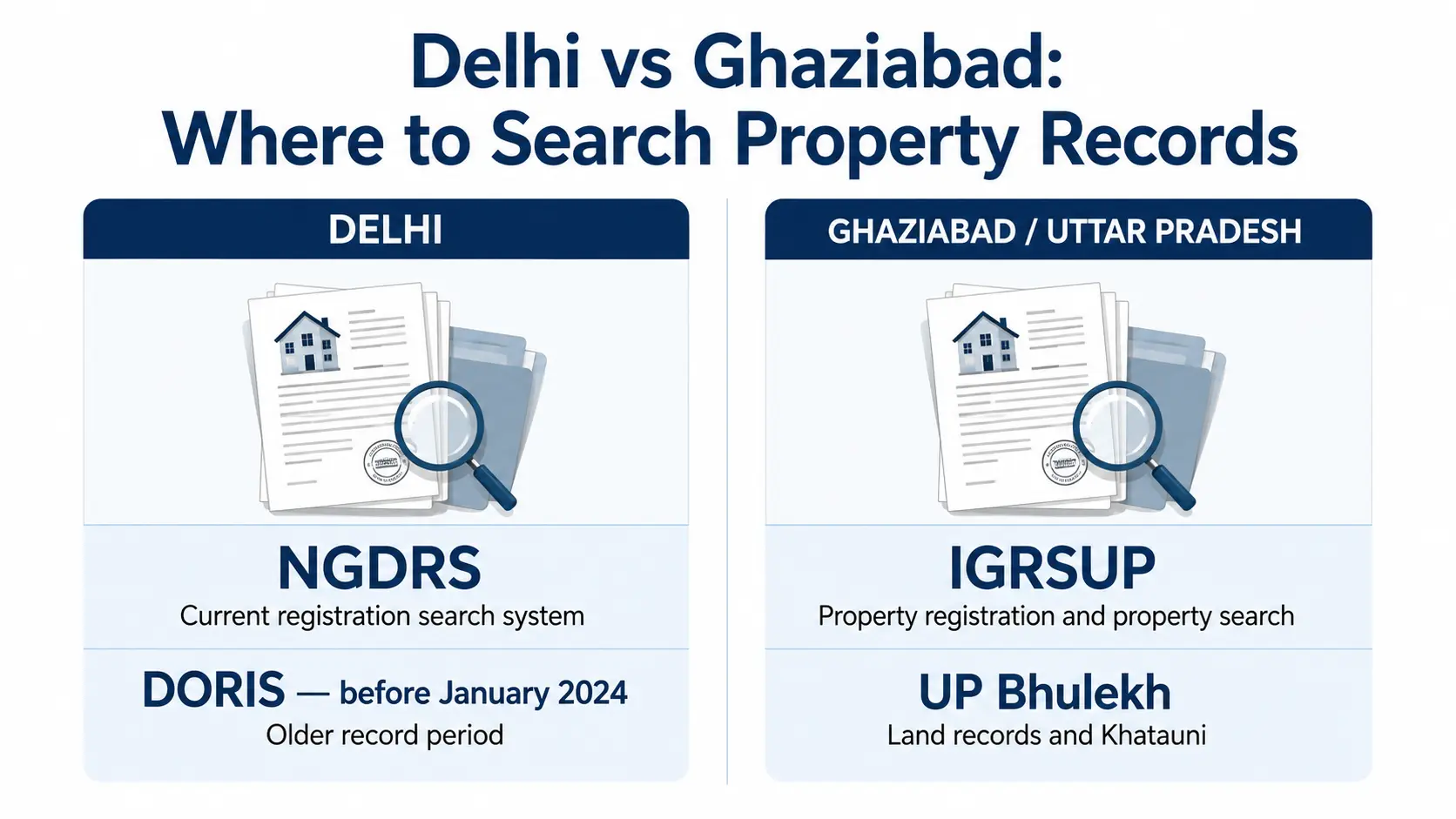
| Property location | Official starting point |
|---|---|
| Delhi | Delhi NGDRS / registration search |
| Older Delhi registration records | DORIS-period search |
| Newer Delhi registration records | NGDRS-period search |
| Ghaziabad | IGRSUP |
| Uttar Pradesh land records | UP Bhulekh |
| Court-case search | eCourts |
The current Delhi NGDRS portal specifically separates the DORIS period before January 2024 and the NGDRS period after January 2024.
UP’s official registration department currently provides property-search and registered-document services, while UP Bhulekh provides the state’s computerized land-record system.
Property Title Search Checklist Before Paying a Large Amount
Before paying a substantial amount for a property, keep this checklist handy:
☐ Obtain the current bainama (sale deed)
☐ Collect previous transfer documents where relevant
☐ Note the registration number and date
☐ Note the Sub-Registrar office
☐ Record the property identifiers
☐ Search the relevant government registration records
☐ Check relevant land/revenue records
☐ Check Khatauni where applicable
☐ Check dakhil-kharij (mutation) where applicable
☐ Compare the seller’s name
☐ Compare property description
☐ Compare area and identifiers
☐ Check relevant court information
☐ Check encumbrance-related information where applicable
☐ Ask about missing documents
☐ Investigate inconsistencies
☐ Do not treat one online record as conclusive proof of clear title
What If the Online Record and Bainama Do Not Match?
Don’t ignore the difference.
A mismatch does not automatically mean that the seller is dishonest or that the property has defective title.
There may be a genuine explanation.
But before proceeding, you should find out:
- Why is there a difference?
- Which document is being relied upon?
- Is there another document explaining the difference?
- Does the registration record support the transaction?
- Do the relevant land records correspond?
- Is there a relevant court or revenue proceeding?
- Does the issue require legal examination?
The Registration Act contains provisions requiring adequate description of property in documents relating to immovable property.
When Should You Ask a Property Lawyer to Review the Documents?
A property lawyer may be useful when:
- the ownership history is complicated
- important documents are missing
- names don’t match
- property identifiers don’t match
- inheritance is involved
- multiple previous transfers are involved
- a court case appears
- an encumbrance is suspected
- a Power of Attorney is involved
- the property is being purchased from a builder
- you are investing a substantial amount
- you cannot understand how the seller acquired the property.
If you are dealing with a property issue in Ghaziabad or Delhi-NCR, you can also explore our property legal services for title checks, documentation, property transfers, disputes and related property matters.
What If You Are Already Facing a Property Dispute?
A title search is not the same thing as handling an existing property dispute.
If your issue involves:
- ownership
- possession
- partition
- boundary
- encroachment
- competing claims
- a disputed transaction
you may need a separate legal assessment.
You can learn more about our property dispute legal services.
What If You Are Buying a Builder Property?
A builder purchase can involve additional documents and issues.
Depending on the transaction, you may need to examine:
- builder-buyer agreement
- allotment documents
- possession-related documents
- payment records
- project-related information
- applicable RERA information
- other transaction documents.
For builder-buyer and RERA-related matters, see our RERA & Builder-Buyer Legal Services
Frequently Asked Questions
How do I check property title online?
Start with the official registration and land-record system for the property’s location. Delhi has its official NGDRS/DORIS registration search, while Uttar Pradesh provides IGRSUP and UP Bhulekh.
How do I check property ownership in Delhi?
Use the official Delhi registration-search system and compare the available result with the seller’s documents. The current Delhi system separates DORIS-period records before January 2024 from NGDRS-period records after January 2024.
How do I check property records in Ghaziabad?
Start with IGRSUP for property-registration information and UP Bhulekh for land records.
Can I search property cases online?
Yes. The official eCourts system allows searches using party name, case number and other search methods.
Does mutation prove ownership?
No. The Supreme Court has repeatedly held that mutation entries do not themselves confer title and serve a fiscal/revenue purpose.
Is an online property search enough before buying?
It is a useful preliminary check, but it should not automatically be treated as complete legal title verification.
What is a bainama?
Bainama is a commonly used Indian property term for a sale deed or sale document. The legal effect of the document depends on the transaction, applicable law and the facts of the property.
What is Khatauni?
Khatauni is a land/revenue record used in Uttar Pradesh. The official UP Bhulekh system provides computerized land records and Real Time Khatauni.
What is dakhil-kharij?
Dakhil-kharij is commonly used to refer to mutation or the recording of a change in relevant revenue records. Mutation itself does not confer title.
How many years of property records should I check?
There is no single fixed period that should automatically be applied to every property. The appropriate scope depends on the property, documents, ownership history and circumstances.
Final Takeaway
A property title search is more than checking the seller’s name online.
For a property in Delhi, start with the official registration-search system and check the appropriate DORIS or NGDRS period.
For a property in Ghaziabad or Uttar Pradesh, use the official IGRSUP registration/property-search services and UP Bhulekh land records.
For relevant court information, the official eCourts system can be another useful search step.
Most importantly, don’t assume that one online record, a mutation entry or even one document tells the complete story.
The real purpose of a property title search is to compare the available records and documents and identify anything that needs further investigation before you proceed with the transaction.
Related Property Guides
If you are researching a property before buying, you may also want to read:
Property Legal Services in Ghaziabad & Delhi-NCR — title verification, due diligence, documentation, property transfer and related matters.
Property Lawyer in Ghaziabad & Delhi-NCR — property-related legal assistance in Ghaziabad and the Delhi-NCR region.
Property Lawyer in Delhi — property legal assistance for matters in Delhi.
Property Dispute Legal Services — for ownership, possession, partition and other property disputes.
RERA & Builder-Buyer Services — for builder-buyer and RERA-related matters.